Bathroom storage without drilling
Published on 17 October 2026
In a rented bathroom the walls are often tiled and holes are frowned upon, yet it is the room where you most need hooks, a towel bar and somewhere to put the shampoo. Adhesive fixings can do the job, as long as you choose products made for damp and fit them with care. This guide goes with the one on hanging a picture: the same habits, plus the precautions that are specific to a bathroom.
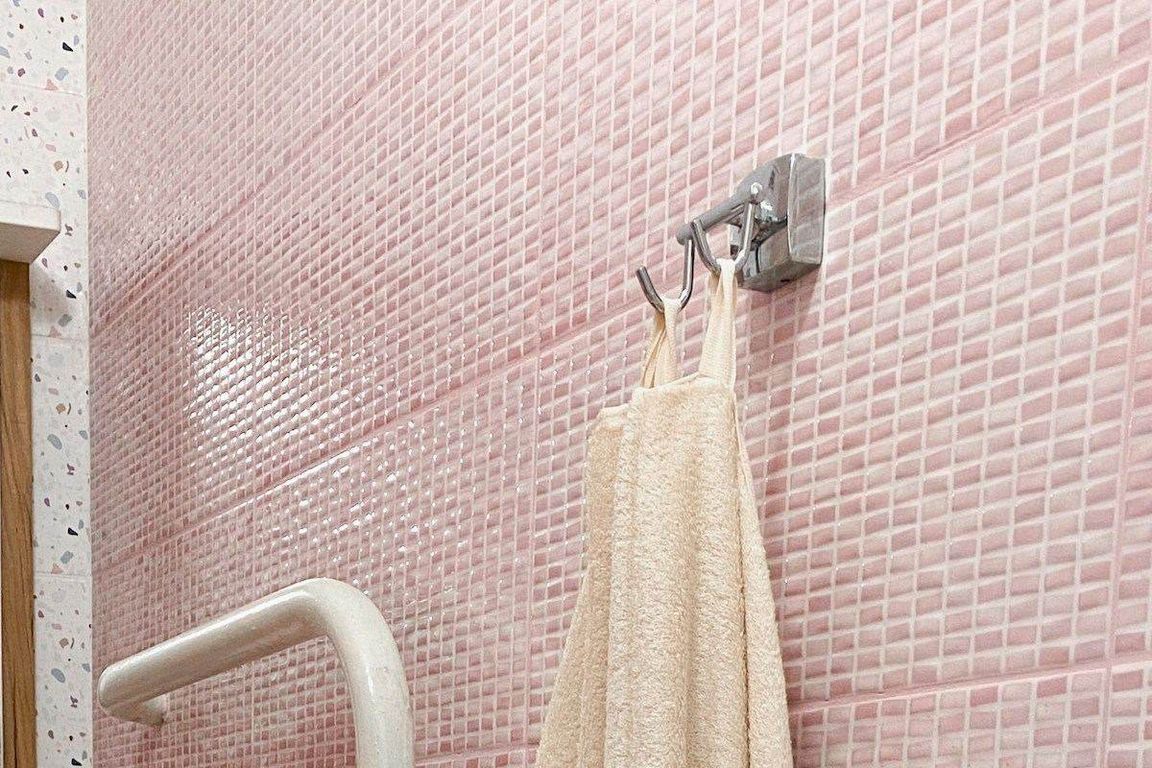
Why a bathroom is a special case
Three things set it apart from a living room. Steam and splashes wet the walls, soap and limescale leave an invisible film on the tiles, and whatever you hang there gets wet too: a damp towel weighs more than a dry one, and a shower caddy fills up with bottles.
An adhesive that holds perfectly well in a bedroom can therefore let go in a shower. Manufacturers make water-resistant strips for this, and that is what we picked for the “Bathroom storage” category of our product pages.
Three questions before you choose
Where will it go?
The compatible surfaces depend on the product and are stated by the manufacturer.
- Tiles and glass (shower screens, wall tiles): smooth, firm surfaces are the safest, and every product in our bathroom selection fits them.
- Painted wall: several Command products fit it too, which helps outside the shower, for example next to the basin.
- Wallpaper, vinyl, delicate surfaces: the manufacturers advise against them for the Command products in this selection.
- Textured tiles or mosaic: smooth surfaces are the safest. Read the instructions and, if in doubt, try somewhere out of sight.
How wet will it get?
A hook next to the basin does not get the same water as a caddy in the shower. As soon as the product is exposed to steam or splashes, pick one whose manufacturer states water resistance. The Powerstrips Waterproof Large hooks hook, for instance, is stated to go directly in the shower.
How much will it carry?
Weigh what you plan to hang, and add it up: a shower caddy full of bottles, a wet bath towel. Pick a fixing whose maximum load is higher, with room to spare. The loads in our selection run from 1.3 kg to 3 kg: they are modest, so use one fixing per job and do not pile heavy things onto it.
Which product for which job?
The loads below are the ones the manufacturers state and our product pages repeat. Always check the instructions on the packaging before you fit anything.
- Shampoo, shower gel, razor: Command shower caddy BATH31, up to 3 kg on tiles, glass, metal, varnished wood or a painted surface, with water-resistant strips.
- A hook in the shower or on wall tiles: Powerstrips Waterproof Large hooks, up to 2 kg on tiles or glass, reusable with Powerstrips Waterproof Large refills. Or Command water-resistant hook BATH43, up to 1.3 kg on glass, tiles, varnished wood or a painted surface.
- A towel by the basin or the bath: Command towel bar BATH42, matte black, 30 cm, up to 1.3 kg on glass, tiles or a painted wall. It can be repositioned with a new medium water-resistant strip.
- Several hooks in a dry part of the room: Command medium hooks, pack of 7, 1.3 kg each on smooth surfaces. This pack does not state water resistance: keep it for places the steam does not reach.
For a picture or a poster in the bathroom, see the guide on pictures.
Fitting it, step by step
- Choose the spot and mark it with a light pencil line or a small piece of masking tape. Check the height against what it will hold: a caddy set too low or a towel dragging on the floor is no use.
- Clean the surface with household alcohol, to remove dust, soap and limescale, then let it dry completely. Never fit one straight after a shower, on a wall that is still steamed up.
- Check the maximum load of the product against the weight of what you will put on it, with room to spare.
- Fit it by pressing firmly, for as long as the instructions say, on the strip first and then on the wall.
- Let the adhesive set before you put any weight on it and before it gets wet. The instructions give the time to wait: it varies from one product to another.
- Load it gradually, starting with something light to feel that the fixing holds.
Mistakes to avoid
- Sticking onto a wet or steamed-up wall. Damp and soap film are the first reasons a fixing lets go.
- Putting a product that is not made for water in the shower. Look for “water-resistant” in the instructions.
- Going close to the maximum load, especially with a shower caddy: the bottles add up. Keep a margin.
- Using it too soon. Wait for the setting time before loading it or getting it wet.
- Sticking onto wallpaper, vinyl or a fragile surface. The fixing may damage it when you take it off.
- Skipping the instructions. Surfaces, temperatures, waiting times, removal: these details change from one brand to another.
Taking the fixings down when you move out
Follow the product’s instructions. With strips, do not pull the object towards you: slowly pull the strip downwards, keeping it parallel to the wall, until the adhesive lets go. The manufacturers say they come off without marks or residue on a surface in good condition, and with no hole to fill. If a little glue is left, take it off gently, without scraping hard, using the method in the instructions.
Before you hand back the keys, walk round the bathroom: clean tiles with no marks or holes are your best guarantee of getting your security deposit back.